The voice of people living with Sickle Cell Disease. Information, education and communication, finally, with our voice.
Showing posts with label Global Awareness. Show all posts
Thursday, March 27, 2014
Understanding Sickle Cell Pain
Samir K. Ballas, MD is a professor of medicine and pediatrics at Thomas Jefferson University in Philadelphia and honorary staff member of HEMORIO, the Hematology Institute in Rio de Janeiro. He formerly directed the Adult Sickle Cell Program of the Commonwealth of Pennsylvania for the Philadelphia Region.
Dr. Ballas knows blood and he also knows sickle cell disease. Who better than he to write a book about sickle cell pain.
His new book Sickle Cell Pain , March 2014 is a 752-page book that links sickle cell pain to basic, clinical, and translational research, addressing various aspects of sickle pain from molecular biology to the psychosocial aspects of the disease.
The book also addresses in great detail inequities in access to care, stereotyping and stigmatization of patients, the implications of rapidly evolving models of care, and recent legislation and litigation and their consequences.
The world is getting smarter about sickle cell disease thanks to people like Dr. Ballas. Cheers to you for this very important life's work!
Sunday, September 15, 2013
Sickle Cell Awareness Month - Globally
Global Sickle Cell Awareness
September is the best time of year. The weather starts to cool down as the earth moves away from the sun's summer heat. And, it is also Sickle Cell Awareness Month. Recently, I'm overwhelmed by the many activities related to this event. People are walking, talking, teaching, and even preaching about sickle cell disease this month.
My heart is very glad.
However, I have been looking for something else. I've been looking for global awareness, global acknowledgement and global assistance for people with sickle cell disease.
PHG's ultimate goal in developing the toolkit is to improve health outcomes of people with congenital disorders and reduce the burden of these disorders.
This toolkit is useful in many ways. Health administrators, health agencies, health departments, or anyone who determines healthcare policy and funding decisions, can use this tool useful in assessing current and planning future health care strategy needs.
If you are a healthcare professional, policy maker or health administrator please pass this information on to the people who make health care assessment and funding decisions in your country.
September is the best time of year. The weather starts to cool down as the earth moves away from the sun's summer heat. And, it is also Sickle Cell Awareness Month. Recently, I'm overwhelmed by the many activities related to this event. People are walking, talking, teaching, and even preaching about sickle cell disease this month.
My heart is very glad.

However, I have been looking for something else. I've been looking for global awareness, global acknowledgement and global assistance for people with sickle cell disease.
Guess what? I think I've found it.
There is a health care assessment "toolkit" created by PHG Foundation for countries to evaluate their health care needs, as it relates various diseases. Thankfully, they have included sickle cell disease.
The PHG Foundation's Toolkit for Health Needs Assessment in Congenital Disorders has “country specific” data from sources like the World Health Organization (WHO).
PHG's ultimate goal in developing the toolkit is to improve health outcomes of people with congenital disorders and reduce the burden of these disorders.
This toolkit is useful in many ways. Health administrators, health agencies, health departments, or anyone who determines healthcare policy and funding decisions, can use this tool useful in assessing current and planning future health care strategy needs.
If you are a healthcare professional, policy maker or health administrator please pass this information on to the people who make health care assessment and funding decisions in your country.
Once they complete this assessment, they just might find justification for providing better health care for people with sickle cell disease.
Wednesday, April 3, 2013
Sickle Cell in Costa Rica - Blood Has No Color
The Foundation for Research and Support for People with
Sickle Cell Disease (FUNDREPA) arose from Marianella Orozco’s life experiences.
The founder
decided to champion the cause of this Costa Rican group because
of its need to ensure sickle-cell patients receive multi and
interdisciplinary care (medical, genetic, psychological, family and
socio-economic) that require and deserve. With this in view, the mission is to significantly
improve their quality of life; as well as arrange programs of information and
disclosure with preventive and sickle cell disease awareness at the national
level.
It’s vision is to represent, mediate, fight, organize,
orient and unify, both nationally and internationally, for people with sickle cell disease and their
families to have a more dignified, just and hopeful view of life.
To that I say, “Amen!”
As a result of a proposed inter-agency task force by
FUNDREPA in October 2006, a Committee was composed in February 2007 of integrated representatives
of five entities with the purpose of developing a joint and systematic work on
sickle-cell disease in Costa Rica.
The representatives of this committee include:
1. TheNational Programme of Neonatal Screening - This is a specialized laboratory for the diagnosis of diseases located in the Center for the Prevention of Disabilities (CPD) in the national children's hospital. (Bingtranslator from Spanish – English)
2. Center for Research in Hematology and RelatedDisorders (CIHATA) at the University of Costa Rica who say 3% of the
population are carriers of hemoglobin “C”(HbC) gene and 8-10% are sickle HbS
gene carriers. (Bingtranslator from Spanish – English)
3.
TheCosta Rican Association of Haematology (ACH) which brings together professionals in medicine and microbiology who are
specialists in hematology and Hematological Immunology and transfusion medicine. They integrate professionals from other
general areas or other specialties in the health field who have an active
interest in hematology. (Bing translator from Spanish -English)
FUNDREPA
educates Costa Ricans on topics related to Hemoglobinopathies (blood disorders),
pain management, Iron Overload, the disabling implications of sickle cell
disease, and emphasis on knowing and exercising their rights.
I always say that sickle cell disease is a blood disorder
that affects people world-wide. FUNDREPA also has a comprehensive list of sickle
cell organizations world-wide on their website LINKs
section.
FUNDREPA is a voice for people with sickle cell disease
in Costa Rica. To that I say, “Thank you and keep up the good (much needed)
work!”
To find out more about check out FUNDREPA
FUNDREPA facebook page
(NOTE: Microsoft Bing translates website to your language www.bing.com/translator)
Saturday, January 26, 2013
Sickle Cell Disease In Ireland
In 2001, the National Children's Hospital in Tallaght, Ireland published a abstract review of sickle cell disease in the Irish Journal of Medical Science. After reviewing patients with haemoglobinopathy (genetic defect of the blood's haemoglogin) their conclusion was: "The increasing number of children presenting with SCD as a result of the increasing refugee numbers requires a comprehensive care approach similar to that required for paediatric haemophilia to ensure optimum care."
That was in 2001. It is now 2013 and the world is a much smaller place with migration & immigration not uncommon in many countries.
In 2009, Irish Medical Times wrote an article"Explosion of sickle cell disease could mean early deaths," they wrote, "There are currently more than 400 children with SCD in Ireland (up from 12 in 2000)."
This was in 2009. If we do the math, in Ireland from 2000-2009 there was a 3,333.00% increase in the number of children diagnosed with sickle cell disease.
In the same Irish Medical Times article, Dr. McMahon, haematologist at Our Lady’s Children’s Hospital in Crumlin, said "There is no service for adults with SCD and neither is there structured funding for children with the disease. “If we don’t get our act together, we’ll have adults dying at age 40 or 45.”
The article further states, "A vulnerable population cannot make noise, and parents of children with SCD have been scared of being deported."
WHAT!!!!!!
To add insult to injury, in 2011 The Irish Times wrote an article, "Stigma is a 'curse' on sickle cell disease." ******Stigma is defined as a badge of shame.***** So, now we have pain, suffering AND stigma for children and adults living with sickle cell disease in Ireland.
It's now 2013, somebody please tell me that Ireland has turned things around and are now addressing the issues that Dr. McMahon described.
She said, “With treatment, patients can go on to lead happy, fruitful lives. Without treatment, it can be a drain on the State until these people die at age 60. This doesn’t need to happen.”
I HEAR YOU Dr. McMahon and people living with sickle cell disease in Ireland. I wonder if the medical community & political leadership in Ireland are hearing you too??????
Check out Ireland Sickle Cell Fund forming in Ireland. Launch Day May 2013.
Sources:
Irish Journal of Medical Science (article archived by US National Institute of Health)
Irish Medical Times
The Irish Times
Monday, January 7, 2013
Sickle Cell Disease - 5% of World Population
Often times people with sickle cell disease are alone in their pain. They usually don't know another person in their community, school or family that has it. As a result, we feel alone in our battle with sickle cell.
I'm here to tell you (and me) that there are people all over the world suffering with sickle cell disease. And thankfully, we are finally joining to advocate, educate and support each other.
The World Health Organization (WHO) says "Approximately 5% of the world’s population carries trait genes for haemoglobin disorders, mainly, sickle-cell disease and thalassaemia."
According to the U.S. Census Bureau, as of January 7, 2013 the world population is 7,058,157,073. That is just the number of people who were "officially counted".
If we do the math, that means about 352,907,854 "officially counted" people have a haemoglobin disorder. If we add numbers of people from places like India, where all cases of sickle cell disease are NOT officially counted, that original number would be far greater.
We are not alone in our battle. Stats on Sickle Cell Disease Internationally.
Statistics are good, we should know how many people are suffering. However, we need more to be done besides counting us. Some organizations like the World Health Organization (WHO) report data and define strategies for prevention and control of diseases (like sickle-cell disease).
In response to a resolution on sickle-cell disease from the 59th World Health Assembly in May 2006, specifically, WHO resolved to:
World Health Organization (WHO) on Sickle Cell
What I'd like to see is WHOs (2013) progress on how well they're doing with those resolutions.......AND, if international health partners have joined to do their part for their countries.
As usual, in 2013 I'm going do my part. I'm going to seek, ask, and speak in behalf of people with sickle cell disease. Same purpose, same mission.
Read more: World Health Organization (WHO) on Noncommunicable or chronic diseases
I'm here to tell you (and me) that there are people all over the world suffering with sickle cell disease. And thankfully, we are finally joining to advocate, educate and support each other.
The World Health Organization (WHO) says "Approximately 5% of the world’s population carries trait genes for haemoglobin disorders, mainly, sickle-cell disease and thalassaemia."
According to the U.S. Census Bureau, as of January 7, 2013 the world population is 7,058,157,073. That is just the number of people who were "officially counted".
If we do the math, that means about 352,907,854 "officially counted" people have a haemoglobin disorder. If we add numbers of people from places like India, where all cases of sickle cell disease are NOT officially counted, that original number would be far greater.
We are not alone in our battle. Stats on Sickle Cell Disease Internationally.
Statistics are good, we should know how many people are suffering. However, we need more to be done besides counting us. Some organizations like the World Health Organization (WHO) report data and define strategies for prevention and control of diseases (like sickle-cell disease).
In response to a resolution on sickle-cell disease from the 59th World Health Assembly in May 2006, specifically, WHO resolved to:
- increase awareness of the international community of the global burden of these disorders;
- promote equitable access to health services;
- provide technical support to countries for the prevention and management of these disorders; and
- promote and support research to improve quality of life for those affected.
World Health Organization (WHO) on Sickle Cell
What I'd like to see is WHOs (2013) progress on how well they're doing with those resolutions.......AND, if international health partners have joined to do their part for their countries.
As usual, in 2013 I'm going do my part. I'm going to seek, ask, and speak in behalf of people with sickle cell disease. Same purpose, same mission.
Read more: World Health Organization (WHO) on Noncommunicable or chronic diseases
Tuesday, September 4, 2012
September - Sickle Cell Disease Awareness Month (2012)


It all begins this week.
The New York Mets is sponsoring a wonderful event at Citi Field Stadium on September 8, 2012. New Yorkers will see, hear and support Sickle Cell Disease awareness through their favorite sport, baseball.
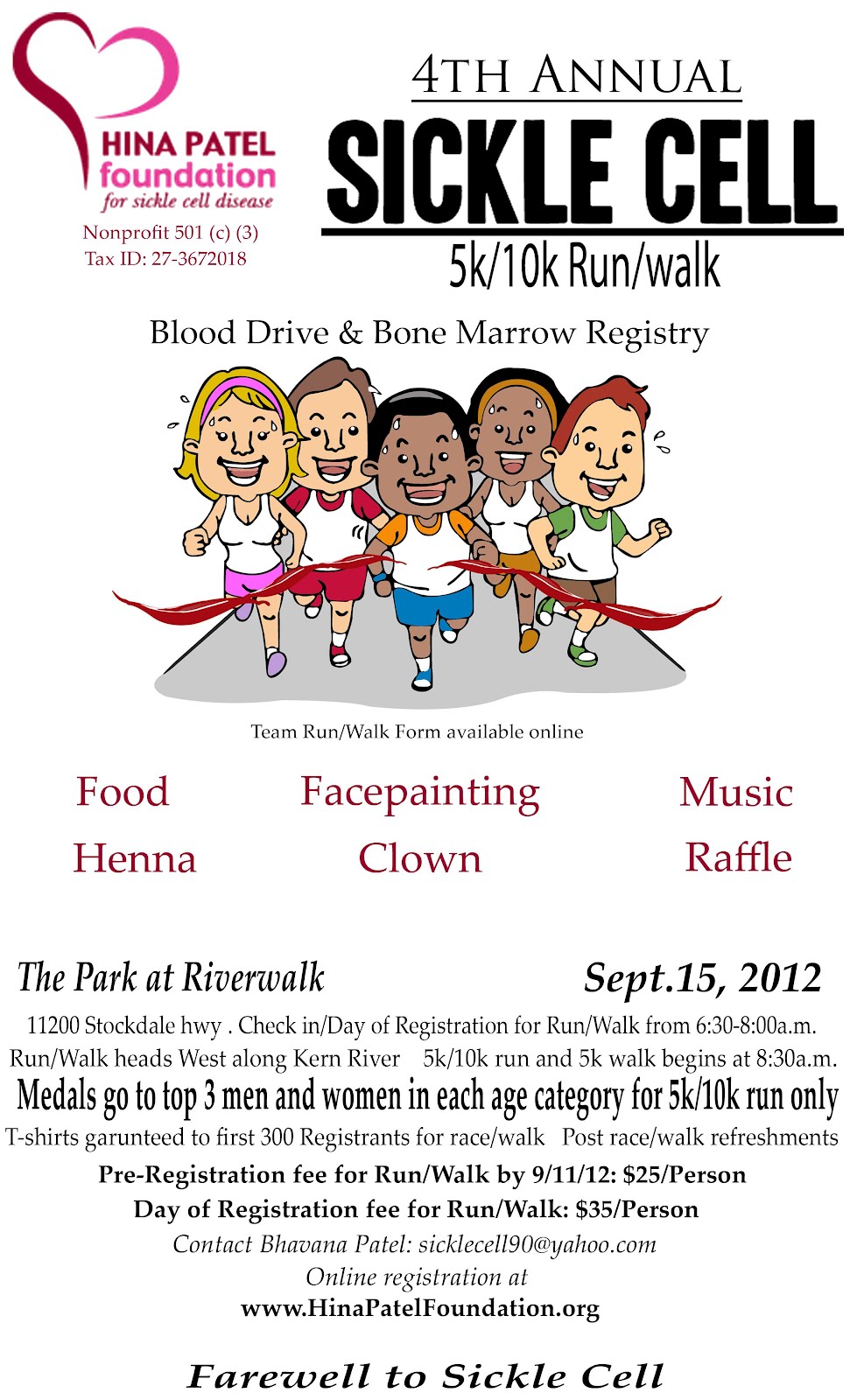
On September 15, 2012, The Hina Patel Foundation is sponsoring a Walk/Run to support Sickle Cell Awareness in California.
See pictures of this event at Flickr.com
The month is full of activities and events to bring awareness to sickle cell disease, as well as, much needed funds to many sickle cell disease related non-profit organizations for the services they provide.
Whatever you do this month to support Sickle Cell Disease Awareness, know that there are people suffering all over the world with no voice, no influence or power. They rely on people like you and me to SPEAK OUT, STAND UP, GIVE our TIME, TALENT & MONEY to support awareness and services for people with Sickle Cell Disease.
I don't have a lot of money, but as long as I have breath I will lend my voice, and anything else that doesn't hurt, to people living with Sickle Cell Disease.

Happy September!!!!!!
For more info about Sickle Cell Disease check out www.scinfo.org
Thursday, April 5, 2012
The Hina Patel Foundation Cares
The Hina Patel Foundation in Bakersfield, CA works to support Sickle Cell Disease awareness and screening programs in India. The quote below is from their recent trip to India 2012:“Sickle Cell camp in India was a huge success. We went to 5 villages (Zankhari, Chakara, Ambach, Mahuvaria, and Surali) and took samples of 3,732 people.
851 had sickle cell trait, 67 had sickle cell disease and approximately 40% of them were newly diagnosed.
They had pain crisis but due to poverty and living far from the city without transportation. These people usually stayed home and suffered with the pain.
We diagnosed a girl about 8 years of age that could not stand or walk due to multiple pain crisis. This was very sad. Her brother also was diagnosed with the disease.
Our foundation provided education about sickle cell, gave each tested person a personal report about sickle cell with explanations. We provided blood grouping to all 3,732 people. Healthy individuals received a “normal” report card with their blood type and on back of the card it tells them the importance of donating blood (a live blood bank for sickle cell patients).
The 851 sickle cell trait individuals got a card indicating they were a “carrier” and on back of the card it explained what it means to be a carrier. The card also explained that these “carriers” should seek genetic counseling when reaching appropriate age to get married and have children.

The 67 individuals with sickle cell disease were given a card that explains what they must do to take care as far as taking medicine, drinking 10 cups of water, dress warm, do not over exert, etc. Each person was given Folic Acid, Larium and Toradol for pain for 1 month. We also set up a program where they will receive these three medications once a month for entire year along and 4 times per year, they will receive CBC (funded by our foundation).
The doctor I worked with also gave check-ups.
Our goal (Hina Patel Foundation) is to continue screening once a year and to keep funding for medication. There are roughly 8 million people that live in this tribal region of Gujarat who mostly carry the sickle cell gene.”
The Hina Patel Foundation is doing their part to support sickle cell disease awareness, treatment and care. They are an example of doing something……anything for your fellow man, woman and child with sickle cell disease.
Thank you Hina Patel Foundation, the angels in heaven are smiling down on you.
Visit The Hina Patel Foundation website to find out more and to donate to their efforts.
Monday, October 31, 2011
Global Sickle Cell Awareness

My personal crusade is to have Sickle Cell Disease recognized as a “blood disorder” and not a “black disorder.” This is not to ignore the truth about its origin. In regions of the world where malaria is found, nature allowed a mutated red blood cell to exist which had a benefit of preventing malaria. While preventing malaria, the mutated blood cell was inherited and thus, Sickle Cell Disease became prominent.
What I am interested in is bringing awareness to the fact Sickle Cell Disease is found all over the world.
Yesterday, I read a story about a family from Cameroon who were being deported from England because they were illegal immigrants. That is not the whole problem; the issue was that their three-year old son suffered a sickle cell crisis and deportation proceedings were still continuing. The fact that the child was in the hospital in England, “not moving, with high fever” did not stop deportation proceedings. Education, compassion and awareness was needed in this case.
I read a story about a footballer born in France, playing football in Spain. While he was training with the national team in the high-altitude commune of Tignes, it was announced that he was dropping out of the squad due to suffering severe intestinal pain and stomach cramps as a result of the altitude. A follow-up medical check revealed that the injury required a significant amount of rest. His football club in Madrid later revealed that the injury was due to asthenic syndrome, a secondary condition related to sickle-cell anemia.
Shall I go on?
In these examples, Sickle Cell Disease appears in two different countries. As we bring awareness to this “blood disorder”, maybe that family from Cameroon might have been allowed to stay (compassionately) because their young son was too weak to travel.
And, the footballer in France might have been tested at birth, or prior to playing football like the NCAA does in the USA. He would have then discovered he had Sickle Cell Disease and also, through education, known he could not tolerate high-elevations.
We need global awareness, information, and communication. No shame, no stigma, no medical racism, AND no problem.
Did you know Sickle Cell Disease is found in many nationalities?
(Per Spanish reviewer) ¿Quién está en riesgo?
Muchas nacionalidades: Afro-Americanos, Latino Americanos, Italianos, Griegos, Árabes, Africanos, Caucásicos, Indios.
Yes, in Latin countries too!
Sunday, April 5, 2009
Sickle Cell In India – Part 3
Some people have asked why I posted two previous blogs from a health-care worker in India?
Well, in my opinion, Sickle Cell Disease and Thalassaemia are global problems that are growing. Ignorance and avoidance have limited the recognition that these disorders have a true impact on society. With global immigration increasing, we have to look at the global impact these diseases have on children, healthcare, healthcare cost, and education worldwide.

Currently, there are American voices crying out for people suffering with these diseases, and they are getting things done in America. Thank God. There are no global voices, however, telling the worldwide story of pain, suffering, and health-care limitations related to these two diseases.
As Sickle Cell Disease and Thalassaemia are silently transferred from one generation to another, all voices are important. Hari Prabhakar, from the Sickle Cell Disease Center at Gudalur Adivasi Hospital in India offers his voice, and I gratefully listen.
********************************************************************
Working at the Sickle Cell Center at Gudalur Adivasi Hospital over the past 5 years has taught us a wide variety of things from both a patient and provider perspective.
Existing literature and health authorities continually stress the importance of cultural sensitivity and community consensus as a means of developing an effective healthcare management system. We have certainly found this to be true, but still face challenges in the implementation of effective healthcare programs and must overcome obstacles such as:
Providing awareness of the disease in the Adivasi population - This is extremely difficult when dealing with a population with a strong and widespread belief system. We use members from the Adivasi community as key health educators (in the villages) to help in gaining acceptance and support for the program. However, a lot more needs to be done regarding genetic counseling managed internally and that does not offend Adivasi group’s beliefs.
Confidentiality of test results - Given that awareness of the disease and its causes is still unfamiliar, there exists a fair amount of shame when an individual is labeled with the disease. It is interpreted that a curse is upon them. Cards are given out to document test results of individuals and are coded to be interpreted only by healthcare providers and patients. Explaining blood test results is also the responsibility of an Adivasi health worker, who we feel can best explain the disease to the patient and instruct them on the appropriate course of action.
Getting medications - Medications like Hydroxyurea (a rather expensive cancer drug used for the treatment of SCD) is hard to get in developed countries where there are areas of geographical isolation. Transportation is too difficult or the patients are migrant workers with little time to take care of themselves. We have tried to stock supplies of critical medications like Hydroxyurea in area Centers throughout the Gudalur valley, where patients can also get their blood tests taken. And, a Sickle Cell Disability Fund is in place to help cover patient transportation costs and make up for lost time in an already unsteady employment situation.
Funding is always a major problem - With the prospects of offering “free” treatment to Adivasi patients and inpatient treatment for complications, we pursue public-private partnerships, private donations/grants, and cross-subsidize from non-Adivasi patients to ensure equity and access in services. Community-based insurance for SCD is also a possibility in order to ensure long-term sustainability and empower patients to become an active part of the financing process.
Researching and developing cheaper more sustainable medicines - In a resource-strained environment where other basic public health needs are minimal, it raises to question the use of Hydroxyurea, the expensive tertiary-care cancer drug. As a result, we have team working to develop a plant-based anti-sickling agent that may be cheaper than Hydroxyrea and more sustainable to produce. In Nigeria, for example, the plant-based drug, Ciklavit, has been shown to have positive results, and we hope that have something similar which could be used locally and internationally.
So, what can we learn for use in the United States?
Regardless of whether we are dealing with a rural village or sprawling metropolis, developing skills of health workers to serve as liaisons to the community is important in gaining support and acceptance. A health service with little confidence from the public will ultimately fail.
There certainly needs to be a push for greater training in SCD among health workers, many of whom could be chosen from the local community to conduct education programs, promote counseling, etc… Complete coverage of the SCD population in the US should be done in tandem with local communities.
Most importantly, however, listening to patients and determining their needs, capabilities, and limitation will play a crucial role in expanding the role of sickle cell programs in the US into a wide-ranging program rather than top-down vertical program.
********************************************************************
( HARI……. Thanks for your contributions to this blog and your suggestions.)
Resources in India
Well, in my opinion, Sickle Cell Disease and Thalassaemia are global problems that are growing. Ignorance and avoidance have limited the recognition that these disorders have a true impact on society. With global immigration increasing, we have to look at the global impact these diseases have on children, healthcare, healthcare cost, and education worldwide.
Currently, there are American voices crying out for people suffering with these diseases, and they are getting things done in America. Thank God. There are no global voices, however, telling the worldwide story of pain, suffering, and health-care limitations related to these two diseases.
As Sickle Cell Disease and Thalassaemia are silently transferred from one generation to another, all voices are important. Hari Prabhakar, from the Sickle Cell Disease Center at Gudalur Adivasi Hospital in India offers his voice, and I gratefully listen.
********************************************************************
Working at the Sickle Cell Center at Gudalur Adivasi Hospital over the past 5 years has taught us a wide variety of things from both a patient and provider perspective.
Existing literature and health authorities continually stress the importance of cultural sensitivity and community consensus as a means of developing an effective healthcare management system. We have certainly found this to be true, but still face challenges in the implementation of effective healthcare programs and must overcome obstacles such as:
Providing awareness of the disease in the Adivasi population - This is extremely difficult when dealing with a population with a strong and widespread belief system. We use members from the Adivasi community as key health educators (in the villages) to help in gaining acceptance and support for the program. However, a lot more needs to be done regarding genetic counseling managed internally and that does not offend Adivasi group’s beliefs.
Confidentiality of test results - Given that awareness of the disease and its causes is still unfamiliar, there exists a fair amount of shame when an individual is labeled with the disease. It is interpreted that a curse is upon them. Cards are given out to document test results of individuals and are coded to be interpreted only by healthcare providers and patients. Explaining blood test results is also the responsibility of an Adivasi health worker, who we feel can best explain the disease to the patient and instruct them on the appropriate course of action.Getting medications - Medications like Hydroxyurea (a rather expensive cancer drug used for the treatment of SCD) is hard to get in developed countries where there are areas of geographical isolation. Transportation is too difficult or the patients are migrant workers with little time to take care of themselves. We have tried to stock supplies of critical medications like Hydroxyurea in area Centers throughout the Gudalur valley, where patients can also get their blood tests taken. And, a Sickle Cell Disability Fund is in place to help cover patient transportation costs and make up for lost time in an already unsteady employment situation.
Funding is always a major problem - With the prospects of offering “free” treatment to Adivasi patients and inpatient treatment for complications, we pursue public-private partnerships, private donations/grants, and cross-subsidize from non-Adivasi patients to ensure equity and access in services. Community-based insurance for SCD is also a possibility in order to ensure long-term sustainability and empower patients to become an active part of the financing process.
Researching and developing cheaper more sustainable medicines - In a resource-strained environment where other basic public health needs are minimal, it raises to question the use of Hydroxyurea, the expensive tertiary-care cancer drug. As a result, we have team working to develop a plant-based anti-sickling agent that may be cheaper than Hydroxyrea and more sustainable to produce. In Nigeria, for example, the plant-based drug, Ciklavit, has been shown to have positive results, and we hope that have something similar which could be used locally and internationally.
So, what can we learn for use in the United States?
Regardless of whether we are dealing with a rural village or sprawling metropolis, developing skills of health workers to serve as liaisons to the community is important in gaining support and acceptance. A health service with little confidence from the public will ultimately fail.
There certainly needs to be a push for greater training in SCD among health workers, many of whom could be chosen from the local community to conduct education programs, promote counseling, etc… Complete coverage of the SCD population in the US should be done in tandem with local communities.
Most importantly, however, listening to patients and determining their needs, capabilities, and limitation will play a crucial role in expanding the role of sickle cell programs in the US into a wide-ranging program rather than top-down vertical program.
********************************************************************
( HARI……. Thanks for your contributions to this blog and your suggestions.)
Resources in India
Tuesday, March 10, 2009
Sickle Cell In India – Part 2
This post is part 2 of a contribution from Hari Prabhakar, from the Sickle Cell Disease Center at Gudalur Adivasi Hospital in India.
The recent 2007 World Health Organization (WHO) and Thalassemia International Federation (TiF) report (see link below) speaks on the need for comprehensive sickle cell centers in developing countries to manage the burden of SCD, and also notes that in the USA, existing centers only cater to 18,000 of the 80,000 affected. In India, there are around 5 million carriers and up to 20 million affected, and most of those affected, primarily Adivasis, live in areas with little access to basic health facilities.
In the south Indian state of Tamil Nadu, in the Gudalur Valley of the Nilgiris District, there is a tribal (Adivasi) population of over 25,000 who have lived in the area for thousands of years. Until 1913, there was a high prevalence of malaria, which could explain why the sickle gene and sickle cell disease has persisted for so long. Within the community, historically mysterious deaths and suffering were regarded as “Doshams” or curses. There was almost no awareness or concept of genetic diseases.
In the past, hydration therapy and vitamin supplementation remained the primary means of dealing with patients at Gudalur Adivasi Hospital. The hospital has doctors, nurses, and health workers, a large percentage of whom are Adivasis trained from the community. Unfortunately, we didn’t have a good idea of the prevalence of the disease in the area.
After reviewing some of the existing literature, doing some internal studies, securing startup funds, and talking to some hematologists, we launched the Sickle Cell Disease Center at the Gudalur Adivasi (Tribal) Hospital. The platform of our Center, now 5 years in existence, has been to emphasize screening, treatment, education, and research, and to serve as a national model for SCD nationwide. Realizing the cost of management of the disease would be out of reach for the population, we decided to offer all services free.
The first step in ensuring the effectiveness of the program was to bring awareness of sickle cell disease to the local population. Thanks to the hospital’s longstanding presence and community outreach, we have been able to deploy the Adivasi health workers to educate, while also providing comprehensive services including Hydroxyurea, penicillin, and pneumococcal vaccinations. Unfortunately, the pneumococcal vaccine for children under 5 is not yet available, but thanks to public health professionals throughout the world, it will be available in India for our patients soon.

Every month, there are screening camps in the villages to identify patients and carriers, as well as presentations to villages on SCD, led by our health workers. Those identified as patients are brought to the main Center in Gudalur and given appropriate treatment according to their needs.
In the summer months, the monsoon season hits the area and make transportation a tremendous issue. The terrain and lack of roads in the area make it difficult for those who need to come to the main Center for picking up their medications and getting monthly tests. We have stocked the appropriate medications in 8 area Centers of the Gudalur area to enhance patient accessibility
As of now, we have screened around 6500 and have 185 patients, many of them who are non-Adivasi but come from a community called the Chetty’s who also have a high prevalence of the disease. There are still thousands more in the villages who have not been screened and are undetected, and we hope to reach them in the upcoming months and years. Genetic counseling is certainly an important part of the program, and we are working on deploying a Center and field-based program that is culturally sensitive and appropriate.
(see report from World Health Organization on Management of Haemoglobin Disorders)
http://www.who.int/genomics/publications/en/
Good luck Hari with your efforts in India….there IS hope.
THE WORLD IS LOOKING….NOW.
Resources in India
Monday, February 23, 2009
Sickle Cell In India
This post is a contribution from Hari Prabhakar of the Sickle Cell Disease Center, at Gudalur Adivasi Hospital, India.
Sickle Cell Disease (SCD) is truly a global genetic disease, and there has often been a misconception that SCD is found only among those of African/African-American descent. In order to successfully manage the disease internationally and formulate global strategies, it is important that we understand the different types of challenges and lessons learned from sickle cell management from both the patient and provider perspective
As such, I would like to share with you our experiences in managing sickle cell disease amongst an indigenous population in South India, the lessons learned, and how we can use these lessons to improve SCD management in the United States.
Each year in India, 495,000 infants have congenital malformations, 390,000 have glucose-6 phosphorylase enzyme deficiency, 21,400 have Downs Syndrome, amongst the Adivasis population ((indigenous populations in India are also called Adivasis) 9,000 infants are born with Beta-thalassemia, and 5,200 have sickle-cell anemia. Due to inadequate diagnostic, management, and rehabilitation facilities, and lack of comprehensive knowledge/acceptance of the disease, the burden of these disorders among the Indian population is far greater than Western countries, and it is particularly pronounced among indigenous (Adivaisis) population in South India.
Adivasis, who are comparable to the Native Americans of the US, number around 10% of India’s population (around 100 million people!). They have been traced back to 3000 BC, and have genetic similarities to Australian aborigines and African tribes. SCD has the highest prevalence among this population, with up to 1 in 5 people being a carrier, and up to 1 in 20 having the disease.
As such, millions in India suffer and succumb to the disease, with little money, knowledge of the disease, or access to healthcare facilities to seek care. Due to a combination of social neglect, inadequate healthcare infrastructure and research, and lack of grassroots implementation and national policy, there are almost no comprehensive sickle cell programs in India, where it is needed most.
Much like in the United States, it is of utmost importance that those in India suffering from the disease are provided a voice and capability to seek care from one of the most despicable and significant genetic diseases on the planet.
.
Resources in India
Sickle Cell Disease (SCD) is truly a global genetic disease, and there has often been a misconception that SCD is found only among those of African/African-American descent. In order to successfully manage the disease internationally and formulate global strategies, it is important that we understand the different types of challenges and lessons learned from sickle cell management from both the patient and provider perspectiveAs such, I would like to share with you our experiences in managing sickle cell disease amongst an indigenous population in South India, the lessons learned, and how we can use these lessons to improve SCD management in the United States.
Each year in India, 495,000 infants have congenital malformations, 390,000 have glucose-6 phosphorylase enzyme deficiency, 21,400 have Downs Syndrome, amongst the Adivasis population ((indigenous populations in India are also called Adivasis) 9,000 infants are born with Beta-thalassemia, and 5,200 have sickle-cell anemia. Due to inadequate diagnostic, management, and rehabilitation facilities, and lack of comprehensive knowledge/acceptance of the disease, the burden of these disorders among the Indian population is far greater than Western countries, and it is particularly pronounced among indigenous (Adivaisis) population in South India.
Adivasis, who are comparable to the Native Americans of the US, number around 10% of India’s population (around 100 million people!). They have been traced back to 3000 BC, and have genetic similarities to Australian aborigines and African tribes. SCD has the highest prevalence among this population, with up to 1 in 5 people being a carrier, and up to 1 in 20 having the disease.
As such, millions in India suffer and succumb to the disease, with little money, knowledge of the disease, or access to healthcare facilities to seek care. Due to a combination of social neglect, inadequate healthcare infrastructure and research, and lack of grassroots implementation and national policy, there are almost no comprehensive sickle cell programs in India, where it is needed most.
Much like in the United States, it is of utmost importance that those in India suffering from the disease are provided a voice and capability to seek care from one of the most despicable and significant genetic diseases on the planet.
.

Resources in India
Subscribe to:
Posts (Atom)